
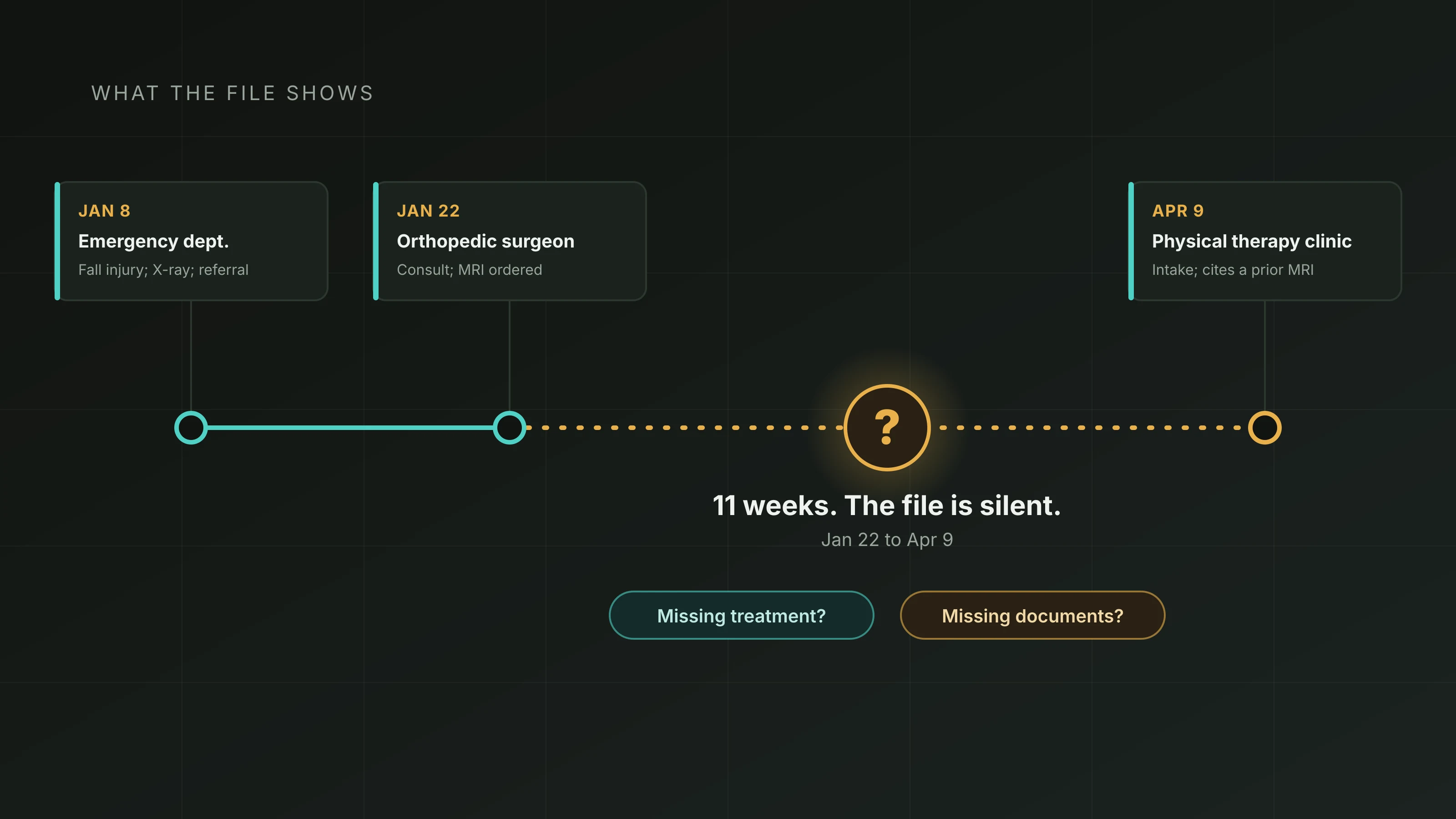
Picture an attorney putting together a demand for a client hurt in a fall. The file shows an emergency room visit the day of the fall, then an orthopedic consult two weeks later. The next entry is a physical therapy evaluation eleven weeks after that. In between, nothing.
The insurance adjuster will see it. A gap that long is easy to read as proof that the client got better, lost interest, or overstated the injury. But the silence could mean something else entirely. The client may truly have stopped treating. A provider may have seen the client and never sent the records. Or the client may have been stuck waiting on an insurance authorization. The file alone doesn't tell you.
That's why finding missing medical records is its own task in case preparation. In this article, we walk through how careful manual review helps legal teams spot gaps, tell a gap in treatment from a gap in documentation, and decide what to ask for next. It's written for attorneys, paralegals, legal nurse consultants, and claims professionals.
Two Kinds of Gaps: Missing Treatment vs. Missing Documents
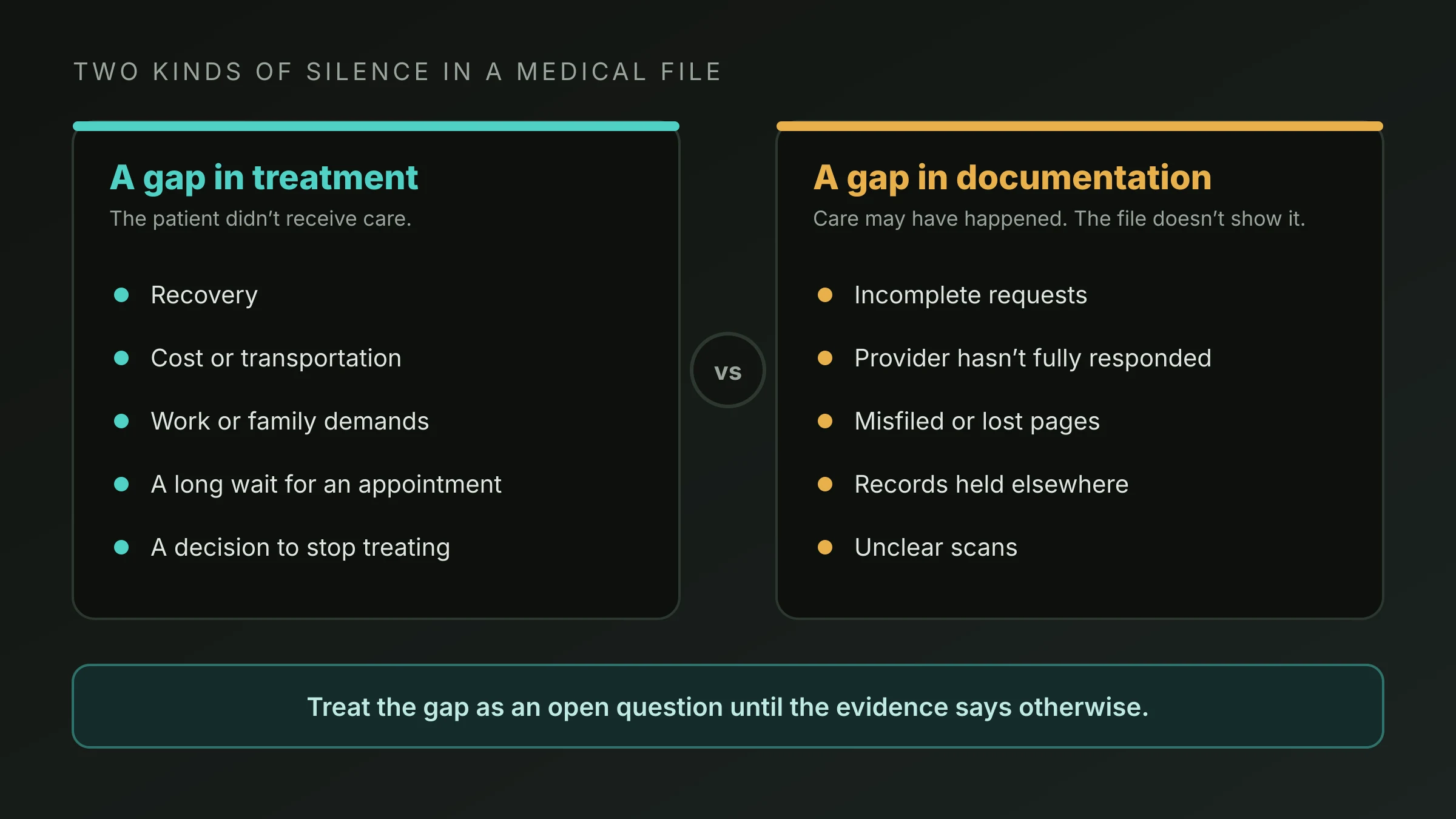
Not every silence in a medical file means the same thing. A good review keeps the possibilities apart.
A Gap in Treatment
A gap in treatment means the patient didn't receive care for a stretch of time. The reasons vary: recovery, cost, transportation, work or family demands, a long wait for an appointment, an unavailable provider, or a decision to stop treating. Whether the gap matters legally is a question for the attorney and the facts of the case.
A Gap in Documentation
A gap in documentation means care may have happened, but the records you hold don't show it. Common causes:
- Incomplete requests. A request covered only certain dates or departments.
- Unproduced records. A provider hasn't responded yet, or only sent part of the chart.
- Misfiled or lost pages. Pages fell out of order, or were attached to another patient's file.
- Records held elsewhere. A visit happened at a facility or practice the team hasn't identified yet.
- Unclear scans. The pages exist, but nobody can read them.
Why the Distinction Matters
A missing document doesn't prove treatment happened. It doesn't prove a provider failed to create a record, or that the patient went without care, either. The responsible approach is to treat a gap as an open question and write down the evidence on each side. That's what separates careful medical record gap analysis from guesswork.
Why This Comes Up So Often in Litigation
Missing medical records in litigation are common because records come from many sources, each with its own request process and response time. Different providers use different systems. Records arrive in batches. A file that looks complete may depend on one more provider nobody realized was involved. For plaintiff and defense teams alike, a documented gap can change how a claim is evaluated, so knowing what is actually missing is worth the effort.
How a Manual Reviewer Investigates: Clues, Timelines, and an Illustrative Case
Why Reading Matters
Gaps are easier to catch when someone reads closely and thinks about what each entry implies. A reviewer going page by page can spot references that point beyond the file. Automated sorting can put documents in order, but it doesn't always recognize what a note implies should exist. A human reader brings the clinical context to ask, "If this was ordered, where's the result?"
Clues That Records May Be Missing
Experienced reviewers watch for signals like these:
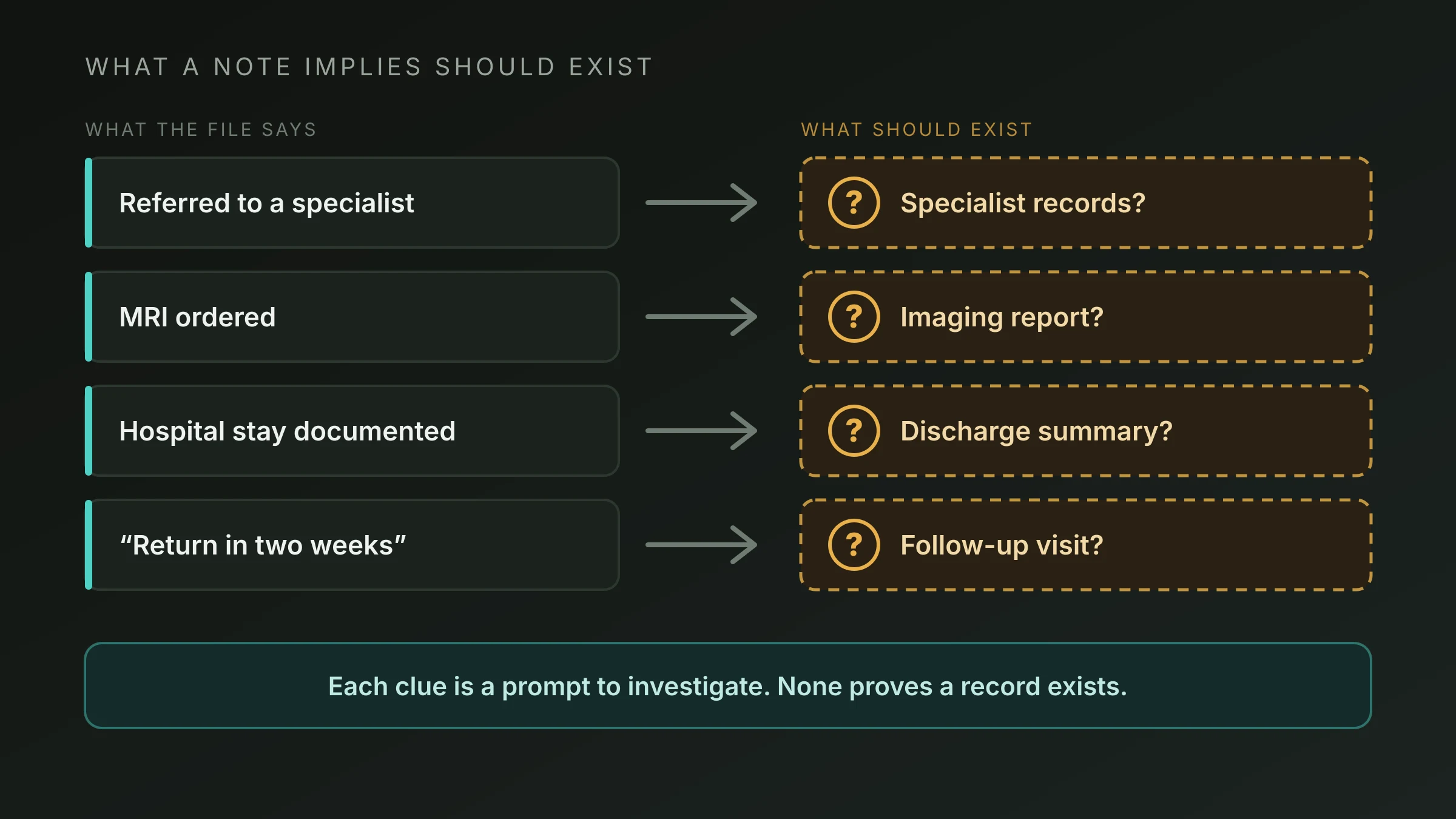
- Referrals without follow-up. A note says the patient was referred to a specialist, but no specialist records appear.
- Orders without results. An MRI, lab, or X-ray is ordered, but no report is in the file.
- Providers named but absent. A history section mentions a physician or facility that has no records in the set.
- Medication changes without a prescriber note. A drug appears or disappears with no matching visit.
- Discharge without a summary. A hospital stay is documented, but the discharge summary or operative report is missing.
- Billing without clinical notes. A charge appears for a service that has no matching note.
- Page-number or date discontinuities. Page sequences skip, or one provider's records stop abruptly.
- Follow-up mentioned but not documented. A note says "return in two weeks," and no later visit appears.
- Records that stop mid-course. Treatment is described as ongoing, yet the file ends.
None of these clues proves a record exists. Each one is a prompt to investigate.
Building the Timeline That Reveals Gaps
Most gaps show up once events are laid out in date order. A reviewer builds a timeline from the records on hand, notes each provider and date, then looks at the spaces between entries and the references that point outside the file. This is the heart of medical record gap analysis: not just listing what's there, but comparing it with what the records themselves suggest should be there.
An Illustrative Case Example
The example below is invented to show the method. It isn't drawn from a real case.
A claimant reports a shoulder injury from a fall. The file contains:
| Date | Provider | Entry |
|---|---|---|
| Jan 8 | Emergency department | Shoulder pain after fall; X-ray; discharged with sling and orthopedic referral |
| Jan 22 | Orthopedic surgeon | Initial consult; MRI ordered; physical therapy recommended |
| Apr 9 | Physical therapy clinic | Initial evaluation; notes prior MRI "showed rotator cuff changes" |
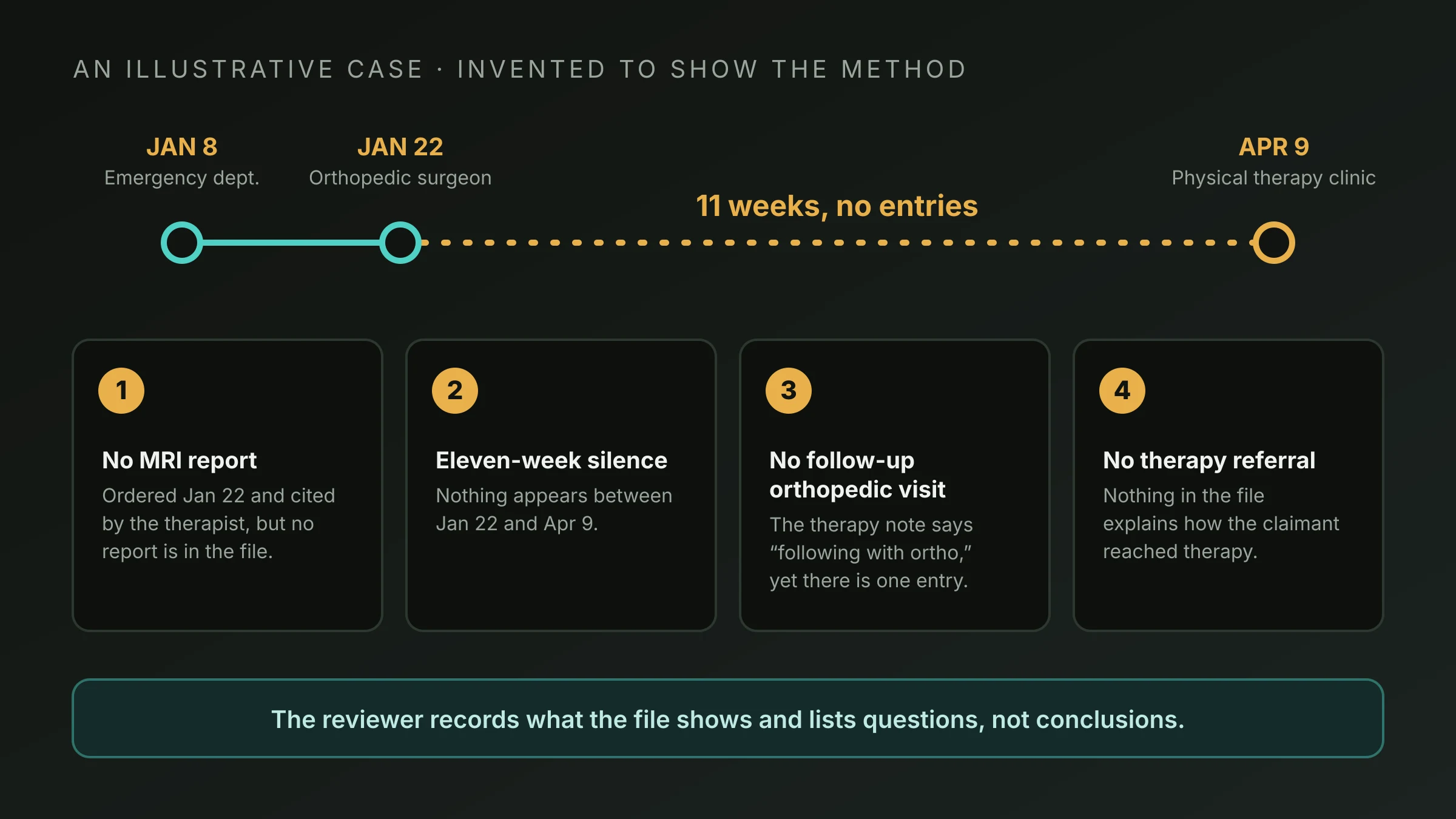
A reviewer comparing the records notices several things:
-
1
No MRI report. The orthopedic note ordered an MRI, and the therapy note refers to its results, but no imaging report appears.
-
2
An eleven-week silence. Nothing appears between January 22 and April 9.
-
3
No follow-up orthopedic visit. The therapy note says the claimant was "following with ortho," yet there is only one orthopedic entry.
-
4
No therapy referral or authorization. Nothing explains how the claimant reached physical therapy.
The reviewer doesn't conclude that the claimant did or didn't treat during that period. The reviewer documents what the file shows and lists follow-up questions:
| Question | Why it matters | Possible source |
|---|---|---|
| Was the MRI performed, and where is the report? | Referenced in two notes; no report in the file | Imaging center or orthopedic office |
| Were there orthopedic visits after January 22? | Therapy note implies ongoing follow-up | Orthopedic practice, full chart |
| What happened between January 22 and April 9? | Eleven weeks without entries | Client interview, pharmacy, insurer records |
| Who referred the claimant to therapy? | No referral or authorization in file | Therapy clinic intake records, orthopedic office |
This question log gives the attorney a clear, organized basis for deciding what to request, which provider to contact, and what to ask the client. It also records the reviewer's reasoning without asserting facts the records don't state.
What Review Cannot Do
Review can flag where records appear to be missing. It can't guarantee that every missing record will be found, and it can't tell you whether a gap helps or hurts the case. Some records may not exist, some may be lost, and some may sit with sources the file never mentions. Treat a gap analysis as a set of leads, not a final inventory.
From Findings to Follow-Up: A Checklist, Requests, and How MLS Human Review Fits
A Checklist for Investigating Missing Medical Records
Attorneys and paralegals can use this list to check the details when a file feels incomplete.
Providers and facilities
- Every provider named anywhere in the file has a matching set of records, or is on a request list
- Provider names, practice names, and addresses are confirmed and consistent
- Specialists and facilities named in referrals are accounted for
Dates and visits
- Treatment dates appear in a continuous timeline, with gaps identified
- Follow-up visits mentioned in notes are matched to later entries
- The date range of each provider's records matches the dates requested
Orders, referrals, and results
- Referral notes have matching consultation records
- Diagnostic orders have matching reports (imaging, labs, tests)
- Procedures have operative reports and related notes
Hospital and procedure documentation
- Hospital admissions have discharge summaries
- Surgical records include operative reports and anesthesia notes where applicable
Medications and billing
- Medication changes are matched to a prescriber note
- Billing statements are compared with clinical documentation
Record quality
- Illegible or incomplete pages are listed
- Page sequences are checked for skipped numbers
How Organized Findings Support Record Requests
Once the gaps are documented, the legal team has a basis for deciding which records to request and from whom. A clear list showing the provider, the date range, the reason a record is expected, and the page where it's referenced makes requests more specific. Specific requests tend to be easier for providers to fulfill than broad ones, and they help the team track what's been requested and what's still outstanding.
How to pursue any request, including authorizations, subpoenas, or deadlines, is a legal question for the attorney and depends on the jurisdiction and the case. A review simply gives the team organized information to work from.
How MLS Human Review Fits
At Medical Legal Spider (MLS), our 100% Human Review solution is just what it sounds like. More than 300 trained medical reviewers read every page by hand, take notes, and build the chronology manually, with no AI involved from the first page to the final file. We call it manual chronology and summary: a full timeline, built page by page. Every deliverable passes through multi-tier quality control involving a reviewer, a senior reviewer, and a project lead.
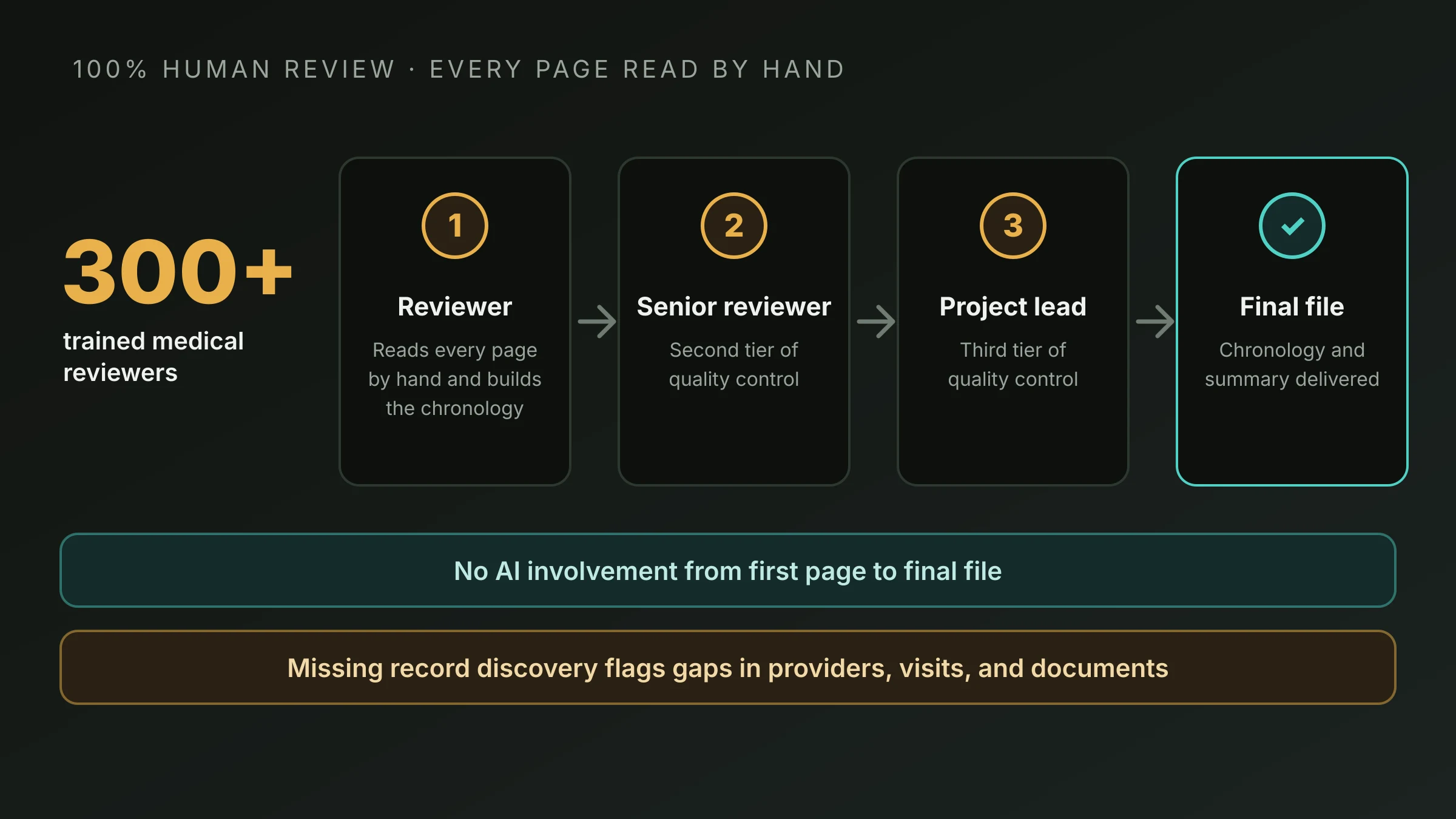
Missing record discovery is part of what we do too. We flag gaps such as missing providers, visits, or documents, and that capability works within each of our review models. We position the human review model for high-stakes litigation, mass torts, and medical malpractice matters.
No review process guarantees that every gap will be found. The value is in a careful reader comparing what the records say with what the file contains, then recording the questions clearly.
Frequently Asked Questions
How can I tell whether a gap is missing treatment or missing documents?
You often can't tell from the file alone. Look for clues such as referrals, orders, or mentions of visits that have no matching records. Then confirm with the provider, the client, and other sources such as pharmacy or insurance records. Treat the gap as an open question until you have evidence.
Does a missing record prove the treatment did not happen?
No. A record may be missing because a request was incomplete, a provider did not respond fully, or pages were lost or misfiled. The reverse is also true: a reference to care in one note doesn't prove the care occurred as described. Verification requires the underlying records.
What are the most common signs of missing provider records?
Common signs include referrals with no specialist records, diagnostic orders with no reports, providers named in a history but absent from the file, hospital stays without discharge summaries, and follow-up visits mentioned but not documented. Skipped page numbers and records that end abruptly are also worth checking.
Why does manual review help with medical record gap analysis?
A person reading the records can understand what each note implies, such as an MRI order that should have produced a report, and can notice the reference that points outside the file. People can also weigh context. Manual review isn't infallible, so quality checks and your own verification of key findings still matter.
What should I do with a list of suspected missing records?
Organize it by provider, date range, and reason, then decide with the attorney which records to request and how. Include the page where each reference appears. We offer a 500-page free trial if you want to see what a human-reviewed deliverable looks like. Check with our team for current terms.
Conclusion: Treat Every Gap as a Question to Answer
Finding missing medical records is less about proving a point than about knowing what the file actually contains and what it only suggests. Careful manual review separates genuine treatment gaps from documentation gaps, flags the references that point beyond the file, and turns scattered observations into a list of specific follow-up questions.
For legal professionals, the practical takeaway is to document gaps with evidence and avoid assumptions in either direction. If your team is working through an incomplete file, you can explore our 100% Human Review service or get started by sharing a file for review.