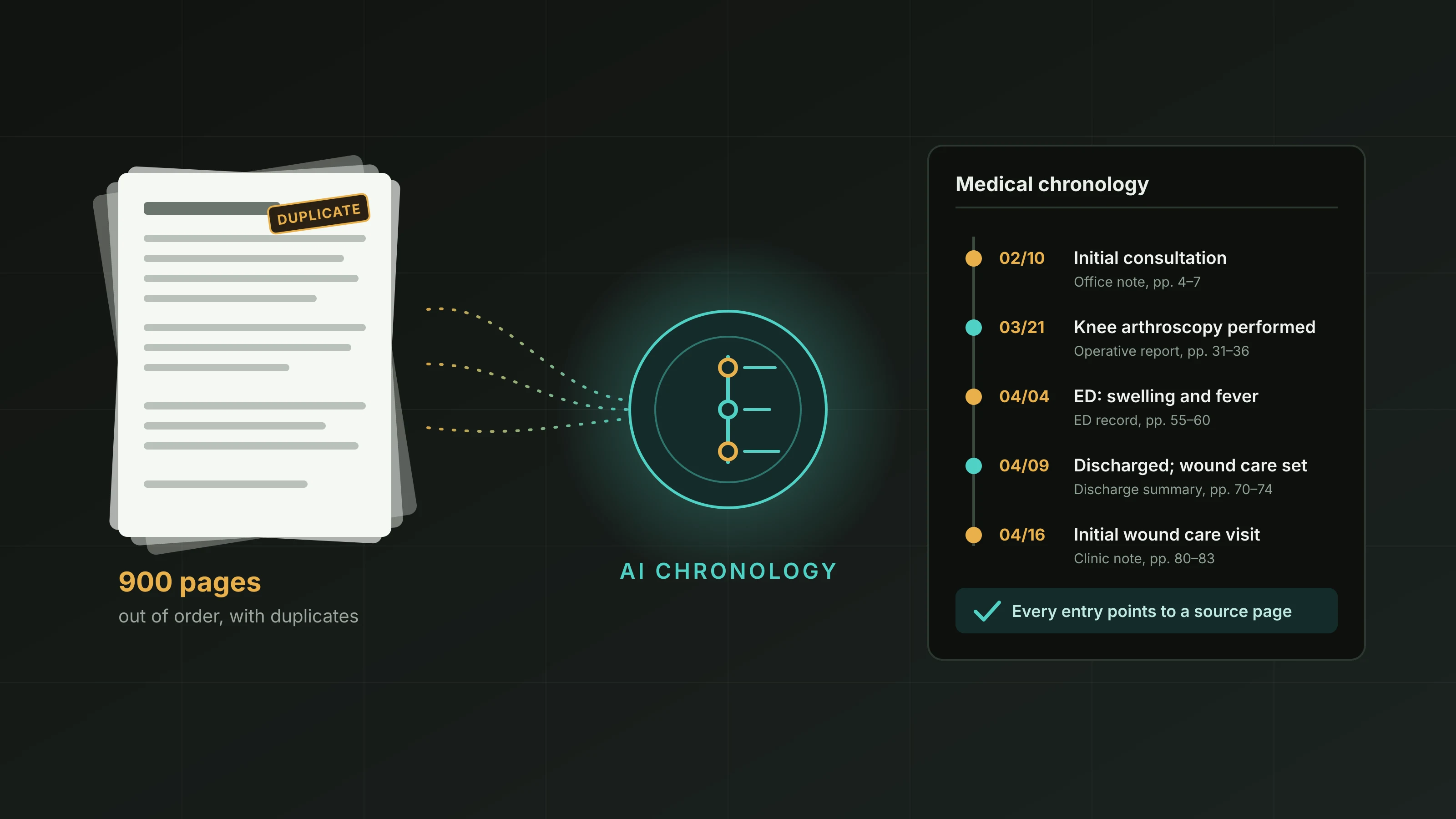
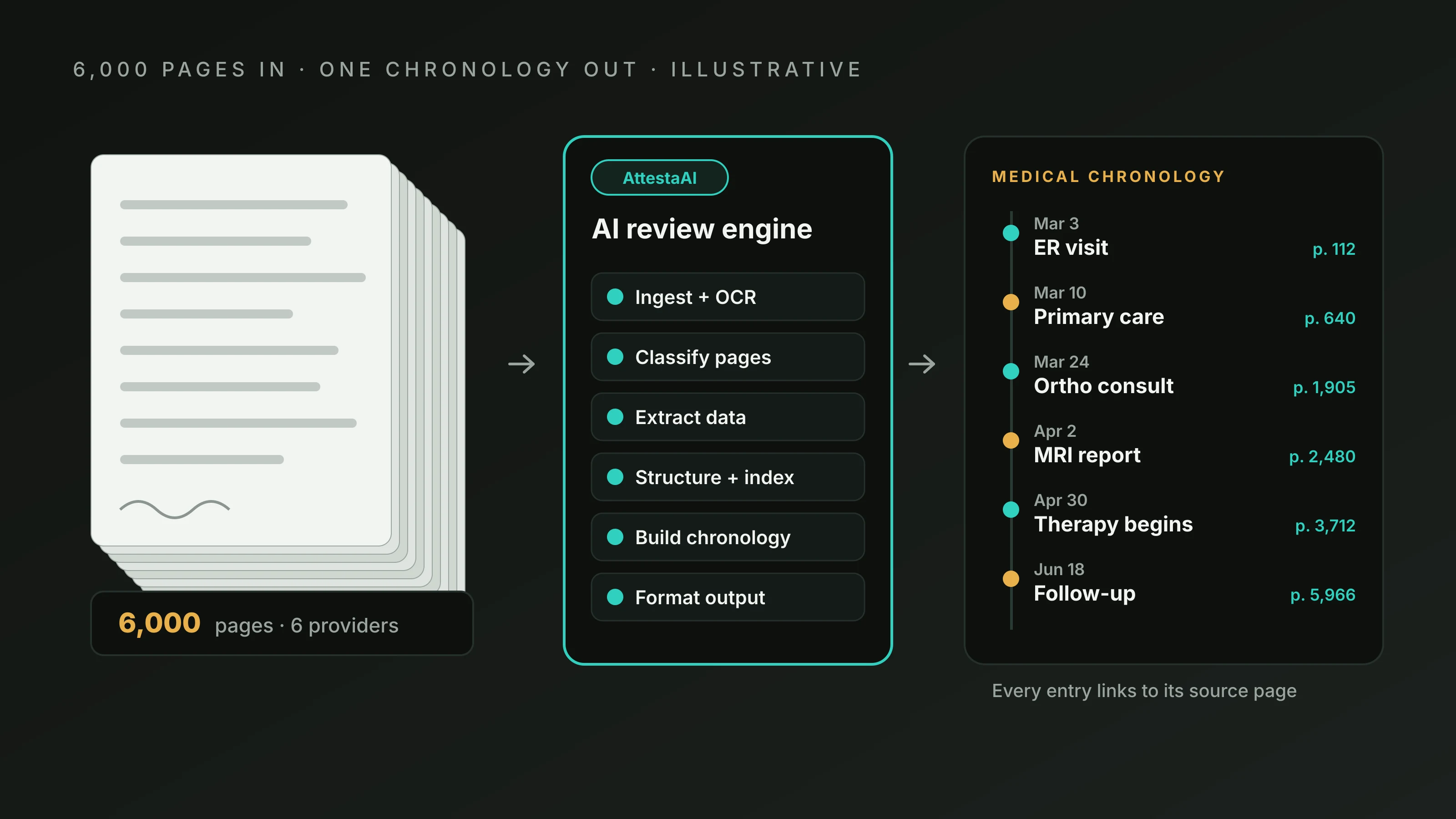
A single injury, malpractice, or claims file can run past several thousand pages. Those pages come from hospitals, clinics, imaging centers, pharmacies, and therapy providers, each with its own format. Reading all of it, sorting it, and building a timeline by hand takes time that attorneys and claims teams rarely have.
That is the problem AI medical record review is designed to address. In plain terms, it uses software to read digital medical records, classify the pages, pull out key information, and organize it into structured outputs such as summaries and chronologies. The software does the high-volume processing, and the output can then be evaluated and used according to the needs of the case.
This article explains how the process works, where it helps, where it falls short, and what to consider when evaluating an AI-based service. It is written for personal injury and defense attorneys, legal nurse consultants, paralegals, insurance professionals, and anyone buying medical record review services.
How AI Medical Record Review Processes Thousands of Pages
What AI Medical Record Review Means
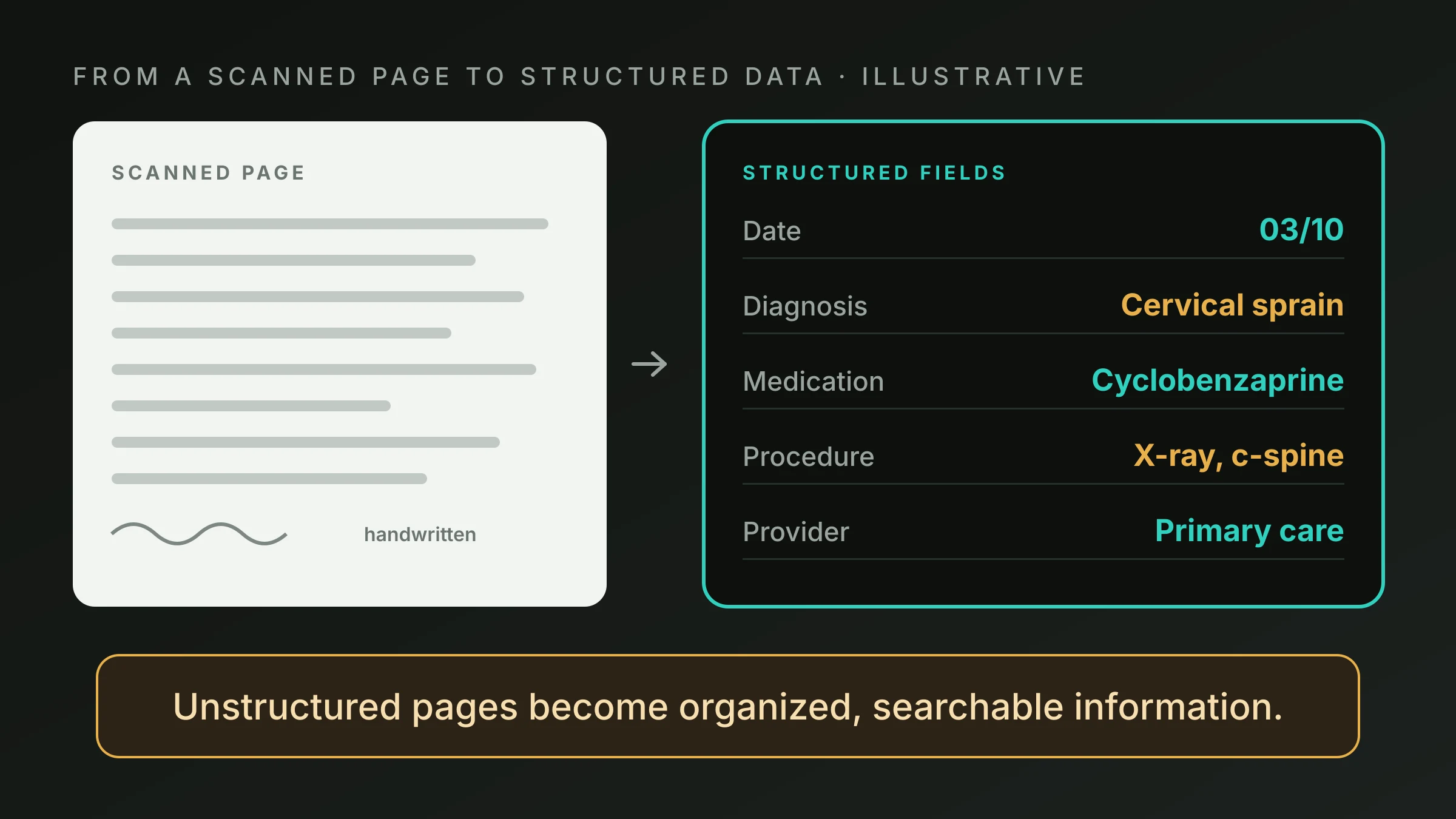
AI medical record review is the use of artificial intelligence to analyze medical records and convert unstructured documents into organized information. The records are usually scanned or digital PDFs, and the AI reads text, identifies relevant details, and arranges them into a format a legal or claims professional can use.
Related terms you may see include AI-powered medical record processing, automated medical record review, and AI medical document analysis. They describe overlapping ideas: software performing tasks that people have traditionally done page by page.
In a 100% AI model, the processing, extraction, and drafting are handled by the AI system rather than by reviewers reading each page manually. That is different from a hybrid workflow, where people verify or finalize the AI output, and from a fully manual review.
The Typical Processing Steps
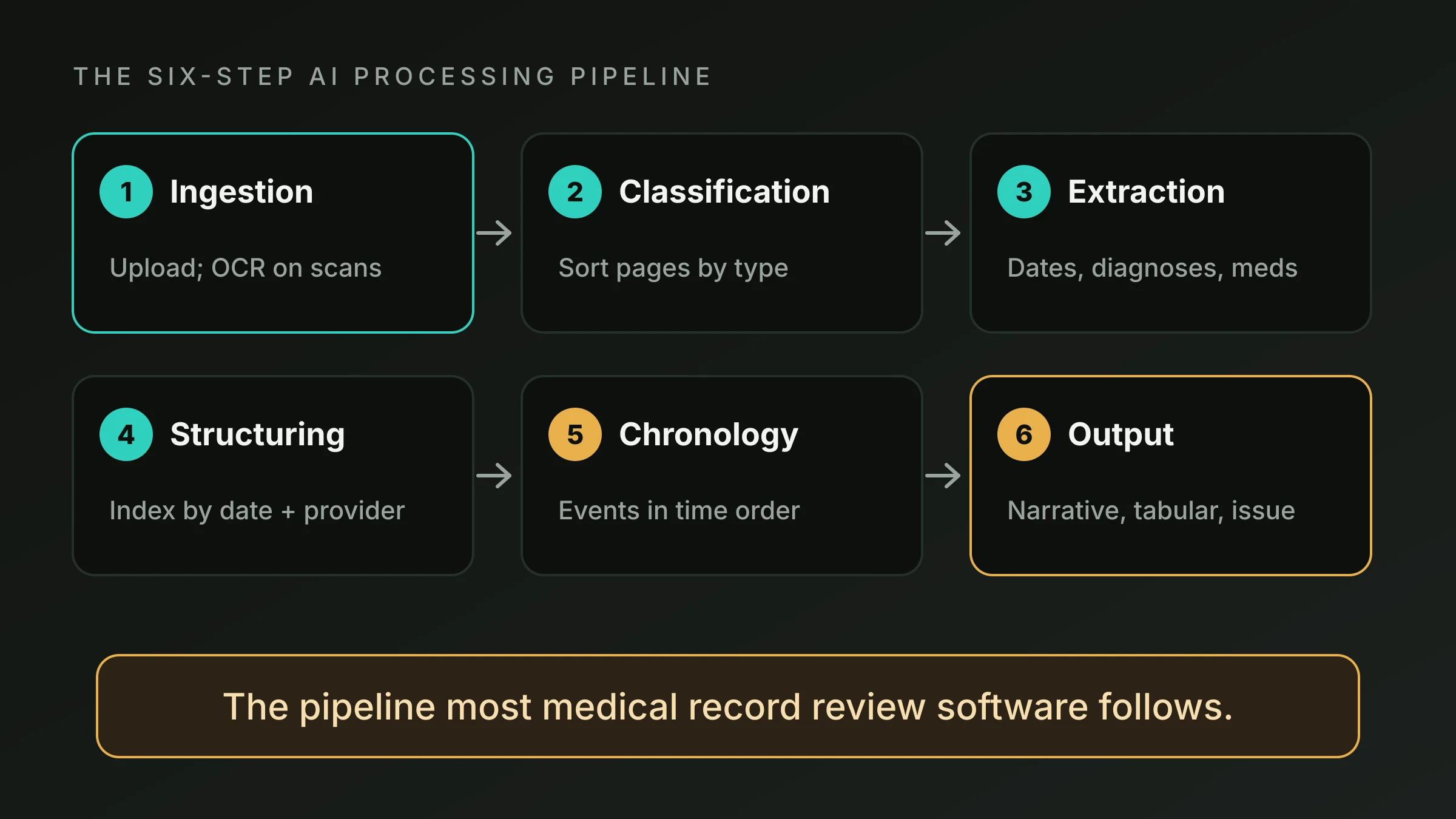
Although tools differ, medical record review software usually moves through a sequence like this:
-
1
Ingestion. Records are uploaded, often as large PDF sets. Scanned pages are converted to machine-readable text using optical character recognition.
-
2
Page and document classification. The system sorts pages by type, such as physician notes, imaging reports, lab results, discharge summaries, or billing statements.
-
3
Automated data extraction. The software identifies specific data points, such as dates of service, diagnoses, medications, procedures, and provider names.
-
4
Structuring and indexing. Extracted items are organized by date, provider, or event type so they can be searched and navigated.
-
5
Summarization and chronology generation. The system arranges events in time order and drafts a summary or medical chronology.
-
6
Output formatting. Results are delivered in a chosen layout, such as narrative, tabular, or issue-focused, where the software supports it.
Each step builds on the previous one. If an early step goes wrong, such as poor text recognition on a faxed page, later steps may inherit the error.
What Kinds of Information Can Be Identified
AI medical document analysis is typically aimed at the elements attorneys and claims professionals look for first:
- Dates: dates of injury, visits, tests, procedures, and hospital stays
- Diagnoses: conditions, symptoms, and clinical impressions
- Medications: drug names, doses, and prescription changes
- Procedures and tests: surgeries, imaging, labs, and therapy sessions
- Healthcare providers: physicians, facilities, and specialties
- Treatment events: referrals, follow-ups, and changes in the treatment plan
Once these elements are extracted, they can feed a chronology, a summary, or a searchable index. Some systems also let users ask questions about the records and receive answers drawn from the file's content. How far any given tool goes depends on its design, so it is worth confirming what a specific product supports.
How Software Organizes Output for Legal Use
Raw extraction is only useful if it is arranged in a way that supports the work. Medical record summarization and medical chronology generation are the most common examples. A chronology lists events in date order with source references. A summary condenses the main clinical picture. Some outputs add tables of medications, provider lists, or issue-specific views focused on topics like prior injuries or treatment gaps.
For attorneys, the value lies in being able to move from a high-level view to the underlying source page quickly. Where a tool links entries to their source pages, a reviewer can check a specific fact without paging through the entire file.
A Practical Example: A Large File for an Attorney
Consider a plaintiff firm that receives a 6,000-page file for a car accident client. The records come from the emergency department, a primary care office, an orthopedic group, a physical therapy clinic, an imaging center, and a pharmacy. Pages are out of order, and some are duplicated.
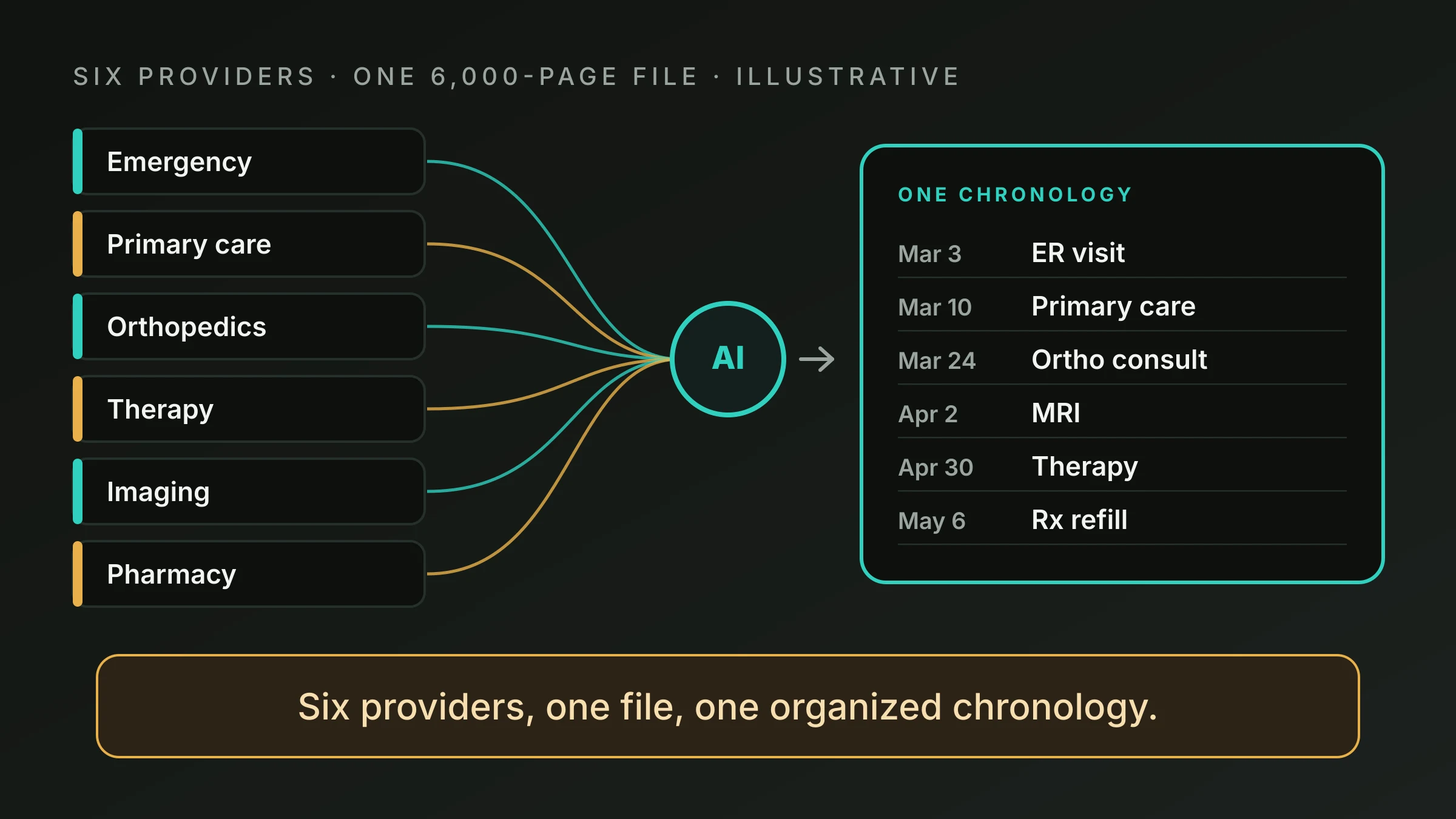
With an AI-driven workflow, the process might look like this:
-
1
The firm uploads the full record set.
-
2
The software classifies the pages and removes or flags duplicates.
-
3
It extracts dates, diagnoses, medications, and procedures from each provider's records.
-
4
It builds a chronology that starts with the emergency visit, follows the orthopedic workup and therapy course, and ends with the most recent visit.
-
5
It drafts a summary that outlines the injury, treatment, and ongoing complaints.
-
6
The attorney opens the chronology, filters to the orthopedic entries, and checks the key events against the source pages.
The result is an organized starting point for evaluating the case, requesting missing records, or preparing a demand. The attorney still decides how much to rely on the output and which entries to confirm before using them.
Benefits and Limitations of AI Medical Record Review
Where Automation Helps
Automated medical record review can offer several practical advantages, especially when files are large:
- Less manual document handling. Sorting, indexing, and first-pass extraction are repetitive tasks that software can perform without a person reading every page.
- Support for high-volume workflows. Insurance and claims teams that screen many files can use automated processing to apply the same approach across a large queue.
- Consistency in structure. A system applies the same template and logic to every file, which can make outputs easier to compare.
- Faster access to relevant events. Structured information lets legal professionals locate specific diagnoses, visits, or treatments without searching through thousands of pages.
Actual time and cost savings vary by file type, record quality, and the tool used, so it is wise to evaluate them on your own records rather than rely on general claims.
What Affects Output Quality
AI output is only as good as the material it processes. Several factors influence results:
- Document quality. Low-resolution scans, skewed pages, and faint faxes can lead to recognition errors.
- Handwriting. Handwritten notes are harder for software to read than typed text.
- Missing records. If a provider's records are incomplete, the chronology will be too, and the software may not know what is absent.
- Ambiguous terminology. Abbreviations and shorthand can have different meanings across specialties.
Risks to Understand Before Relying on Output
AI-generated results carry risks that legal professionals should weigh:
- Incorrect extraction. A date, dose, or diagnosis may be pulled incorrectly, especially from a poor scan.
- Missing context. A software tool may capture a term without understanding whether it describes a current condition, a past history item, or a ruled-out diagnosis.
- Unsupported conclusions. Summaries can sound confident while stating something the records do not actually support.
None of this means automation is unreliable by default. It means outputs should be evaluated before they are used in legal case preparation, particularly when a statement will appear in a demand letter, a deposition outline, or a filing.
When AI-Only Review May Fit, and When More Review May Be Needed
The right level of oversight depends on how the output will be used. The comparison below offers a general guide.
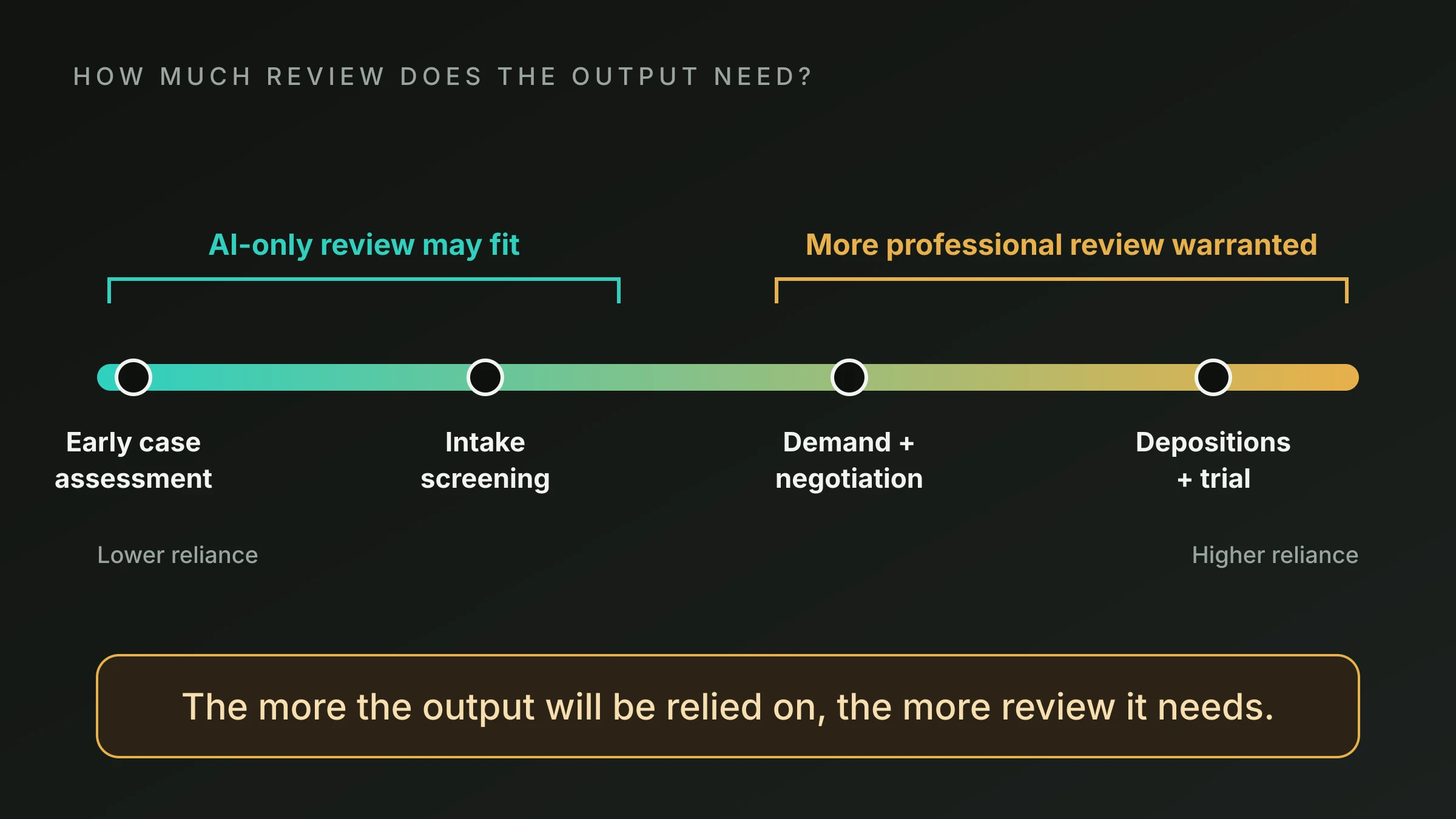
| Situation | AI-only review may be suitable | Additional professional review may be warranted |
|---|---|---|
| Early case assessment | Quick overview to decide whether to pursue a matter | Not usually needed at this stage |
| Intake screening | Sorting many files by basic criteria | If a file looks promising or complex |
| High-volume claims review | Consistent first-pass organization across a large queue | When individual claims are disputed or high value |
| Demand preparation | Draft starting point | Verifying key facts before they are cited |
| Depositions and trial | Background orientation | Strongly recommended for facts that will be relied on |
| Complex, handwritten, or inconsistent records | Initial indexing | Often needed to interpret context and resolve ambiguities |
This table is a framework, not a rule. Each firm and claims team should decide based on the stakes, the quality of the records, and its own risk tolerance.
Frequently Asked Questions
What is AI medical record review?
AI medical record review is the use of artificial intelligence to read and analyze medical records, extract key information, and organize it into outputs such as summaries and chronologies. It is intended to reduce the manual effort of processing large record sets for legal and claims work.
How does AI process thousands of pages of medical records?
The software converts uploaded pages into readable text, classifies them by document type, extracts data such as dates, diagnoses, and medications, and arranges the results into a structured format. Because the steps are automated, the same process can be applied to large files without a person reading each page.
What are the benefits of automated medical record review?
Benefits can include less manual sorting, consistent output structure, easier navigation of large files, and support for high-volume workflows. The extent of those benefits depends on record quality and the specific software, so test it with your own files.
Can AI medical record review software identify important medical events?
It can often identify events such as diagnoses, procedures, medication changes, and provider visits, especially in clear, typed records. Whether an event is important to a given case depends on the legal issues, which is why users should check key entries against the source records.
What are the limitations of AI medical document analysis?
Limitations include difficulty with poor scans and handwriting, missing context, ambiguous terminology, possible extraction errors, and summaries that may state more than the records support. Outputs should be evaluated before being used in case preparation.
How Medical Legal Spider Supports AI-Powered Medical Record Review
MedicalLegalSpider.com (Medical Legal Spider, or MLS) offers three ways to work with medical records: 100% Human Review, 100% AI Review, and an AI plus human hybrid. This article focuses on the 100% AI Review model.
Where AttestaAI Fits
According to the MLS website, the 100% AI Review solution uses AttestaAI, a purpose-built AI agent that reads the case records and produces a chronology, a summary, and plain-English case Q&A. The site describes template options including narrative, tabular, hybrid, and issue-focused formats, and states that the service scales from 500 to 20,000 or more pages. MLS positions this model for early case assessment, intake screening, and high-volume claims review.
The capabilities that support these outputs are described on the site, including automated data extraction for diagnoses, dates, and providers, and medical chronology generation built from the records. Readers who want technical detail about the model can review the AttestaAI engine page, and those with large files can look at the high-volume processing page.
Who It May Help
Based on the use cases MLS describes, an AI-based review may suit:
- Plaintiff and defense attorneys who want a quick, structured view of a record set before deciding how to proceed
- Insurance professionals and claims teams screening or organizing a high volume of files
- Legal nurse consultants and paralegals looking for an organized starting point for their own analysis
What to Consider When Evaluating an AI Medical Record Review Service
Whichever provider you consider, a few questions can help you compare medical record review software and services on substance:
- What exactly is delivered? Ask for sample outputs, such as a chronology or summary, and confirm the formats available.
- How does the service handle poor scans and handwriting? Ask how unreadable content is flagged.
- Can entries be traced to source pages? Linked references make verification easier.
- What level of review applies? Understand whether the output is AI-only, human-verified, or a mix, and match that to how you plan to use it.
- How are records protected? Ask about encryption, hosting, retention, and privacy practices, and request specifics.
- How does it perform on your files? A trial on a representative record set is often the best test.
A Practical Next Step
If you are weighing AI medical record review for your firm or claims unit, the simplest approach is to test it on real material. MLS lists a 500-page free trial, and its site also offers sample deliverables so you can see what a chronology or summary looks like before deciding. You can get started with MLS or use the sample request on the site, and compare the output with your own review standards.
AI can make large medical files far more manageable. The most useful approach is to understand what it does well, know where it needs checking, and choose the level of review that matches the way you will use the results.