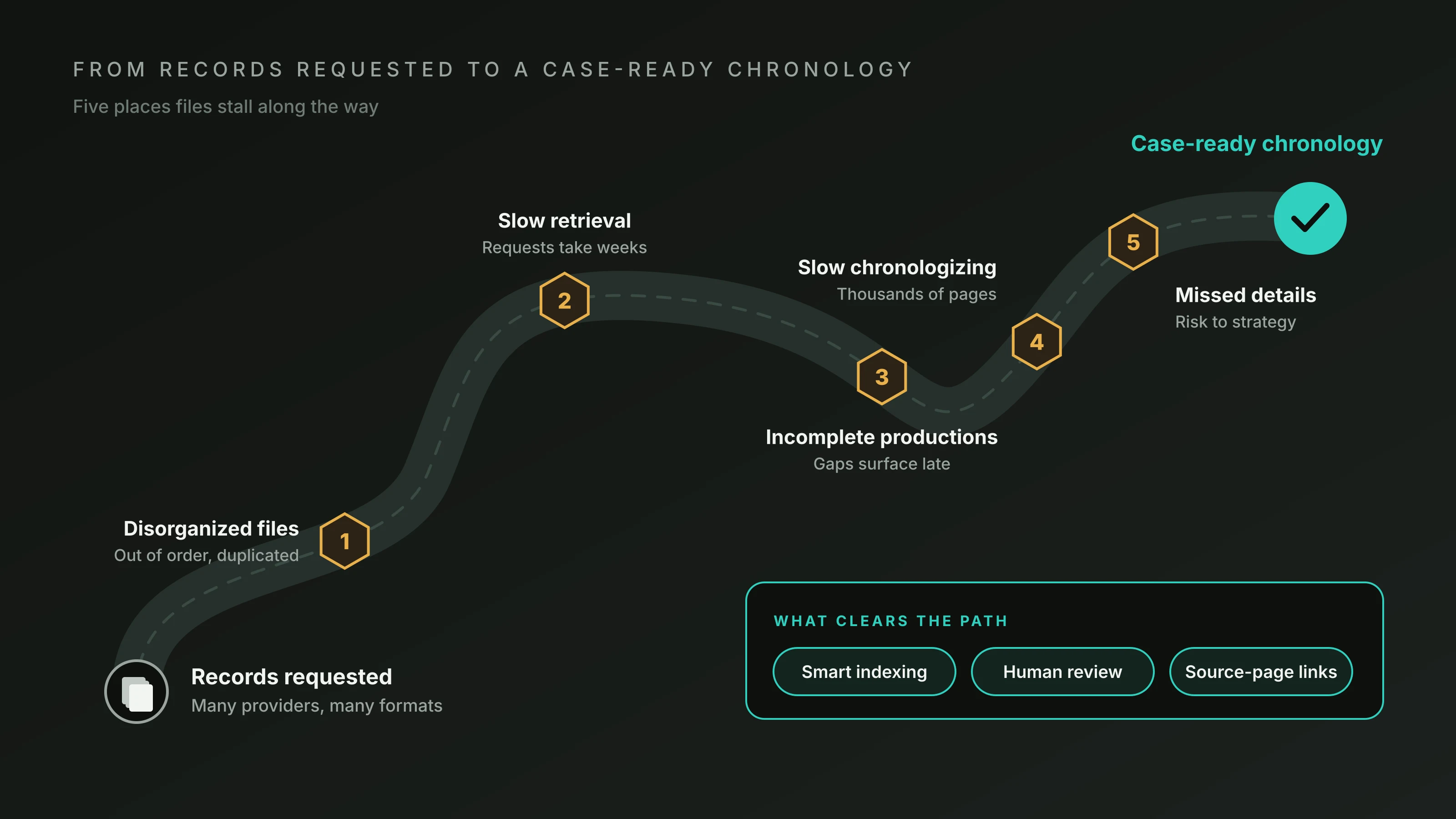
Disorganized records. Slow retrieval. HIPAA rules that rightly limit who sees what. Put those three together and a medical file can eat days before anyone starts analyzing the case.
That's the daily reality for attorneys handling personal injury and mass tort matters, and for the legal nurse consultants and paralegals who build the timelines. Manual review raises the risk of error and pushes back case valuation. At Medical Legal Spider (MLS), we tackle it with AttestaAI-powered analysis, structured indexing and hybrid human-AI review, which we've seen cut record processing and review times by up to 75%.
Why Does Record Disorganization Threaten Case Strategy?
Because it hides the evidence you need at the exact moment you need it. Multi-provider files scatter treatment notes, imaging and billing across different systems. The gaps stay invisible until a deposition or motion deadline shows up. Legal nurse consultants and paralegals often lose hours rebuilding a single treatment timeline that should have been clear from the start.
Unstructured data is its own hazard. A missed referral, a conflicting diagnosis or a gap in treatment can sit buried inside pages of unindexed records. Medical records are central to personal injury litigation: they establish injury severity, prove causation and support damages. When they're disorganized, the valuation of the whole case rests on shaky ground.
What specific risks does disorganization create for law firms?
Firms handling personal injury, medical malpractice and mass tort matters face several risks that compound when records management breaks down:
- Records that obscure the true treatment history and injury progression
- Slow retrieval that delays case preparation and strategy sessions
- More errors when staff cross-reference scattered files by hand
- Compliance exposure tied to strict HIPAA handling requirements
How does buried data affect case valuation?
Adjusters, opposing counsel and juries can't weigh evidence they can't find. A causation link on page 400 of an unindexed chart carries no persuasive weight until someone surfaces it. Settle on a disorganized production and you may leave real value on the table, or miss a defense entirely.
Which Medical Record Types Must Attorneys Track?
Litigation teams track several categories of medical documentation, and each one serves a different evidentiary purpose. Attorneys gather records to prove injury, show treatment, document costs and build timelines that hold up under scrutiny. Miss even one category and the narrative gets thinner.
Personal injury, medical malpractice and mass tort files typically draw from these record types:
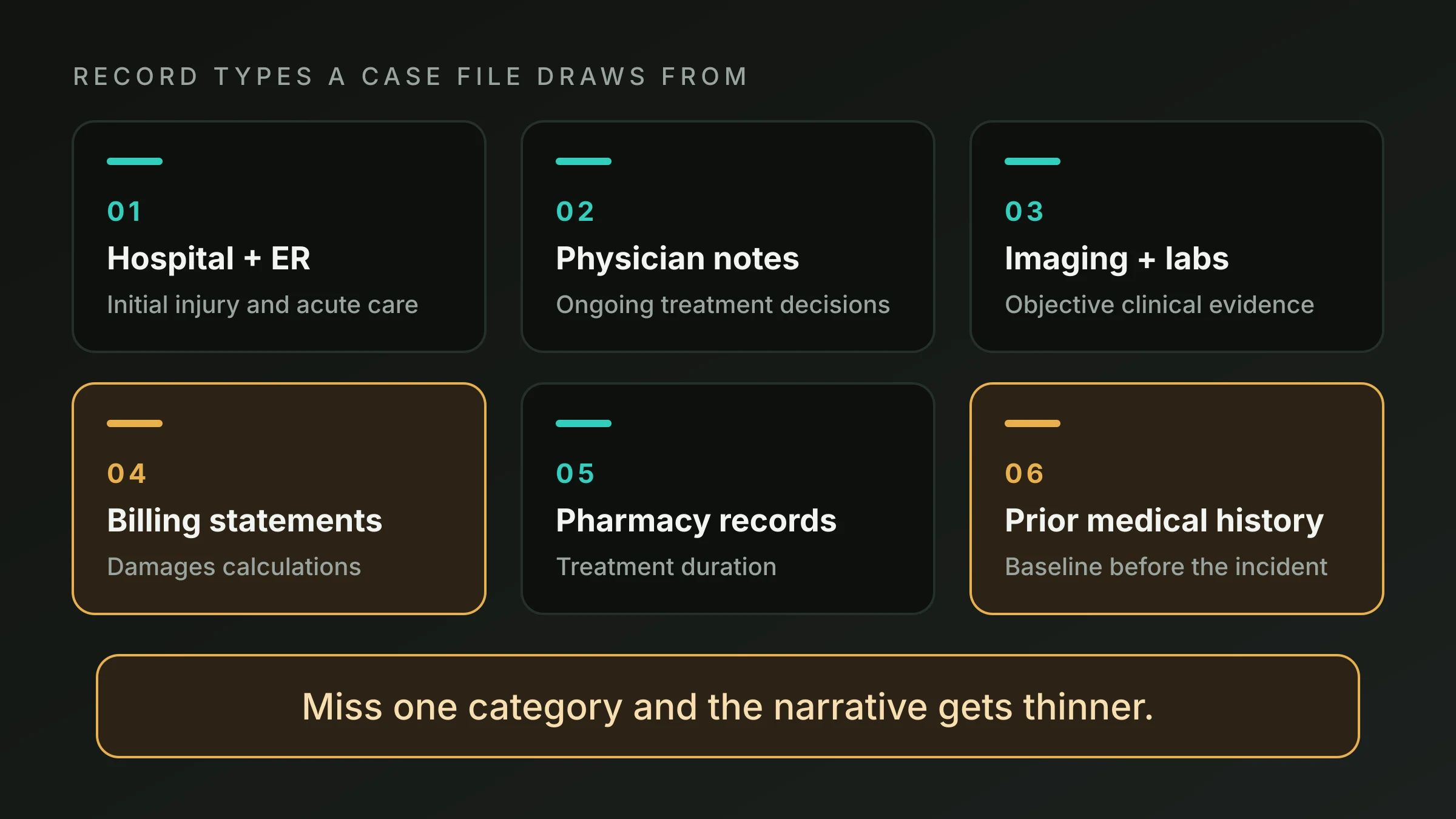
- Hospital and emergency room records document the initial injury and acute care
- Physician office notes and specialist consultations track ongoing treatment decisions
- Diagnostic imaging and lab reports provide objective clinical evidence
- Billing and itemized cost statements support damages calculations
- Prescription and pharmacy records corroborate how long treatment lasted
- Prior medical history establishes baseline health before the incident
Knowing which categories matter most for a given matter cuts delays and sharpens the arguments you make at deposition or trial.
What challenges do attorneys face when organizing and chronologizing medical records for cases?
Legal teams juggle multiple providers, formats and timeframes while trying to build one defensible treatment narrative. Fragmented records arrive out of order, with gaps that obscure causation and injury progression. Disorganized files also slow discovery and invite challenges to authenticity, which is why organizing and chronologizing the file well is such a decisive step in case preparation.
Why does early retrieval matter for record accuracy?
Identifying and requesting the right record types early prevents bottlenecks that stall litigation timelines. Tracking chain of custody and authenticity from the start also protects admissibility later.
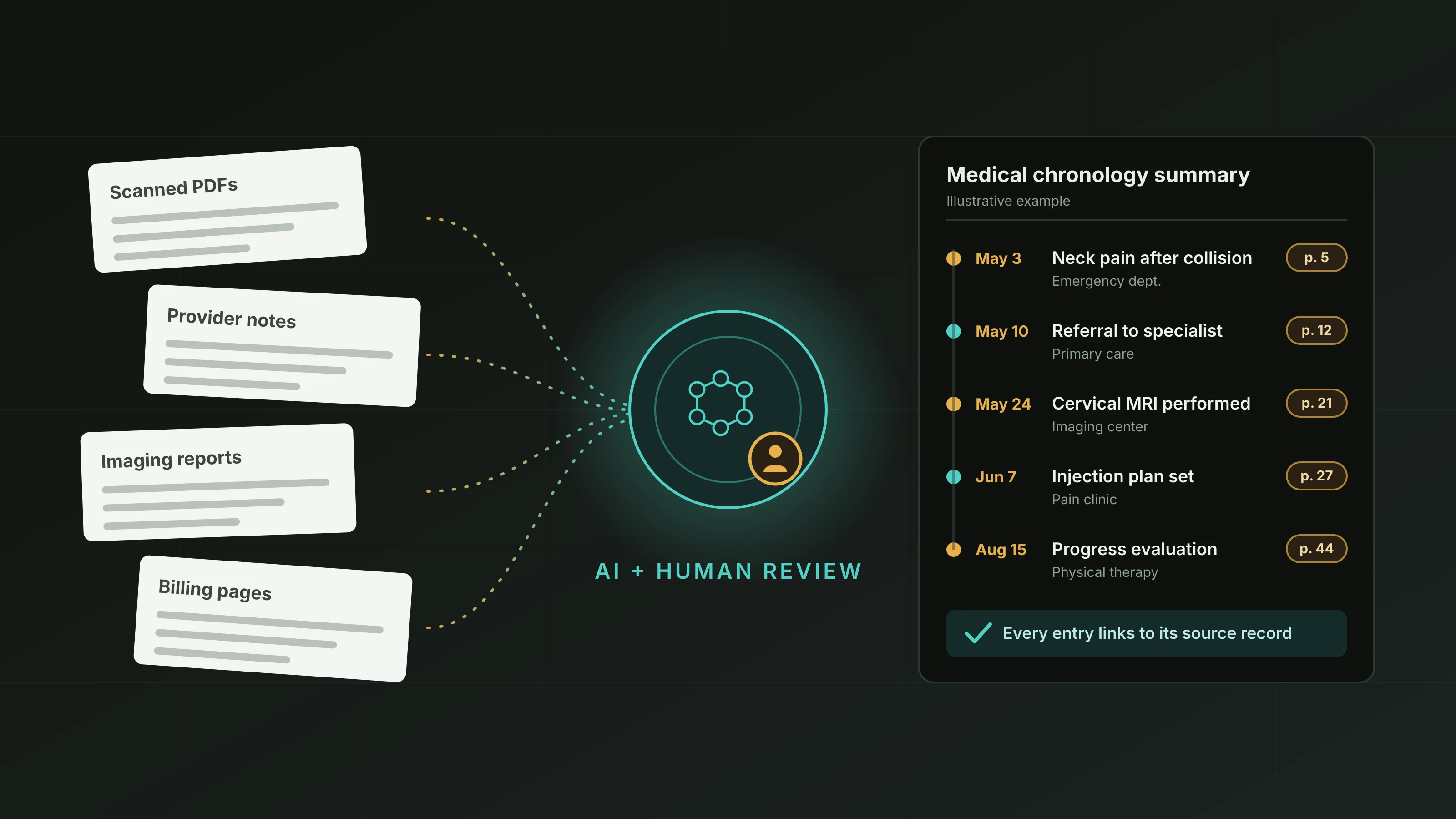
We structure and smart-index records across every category above. The result is case-ready timelines and summaries that keep attorneys, legal nurse consultants and paralegals on the same page, from intake through trial.
How Does Manual Retrieval Slow Down Case Timelines?
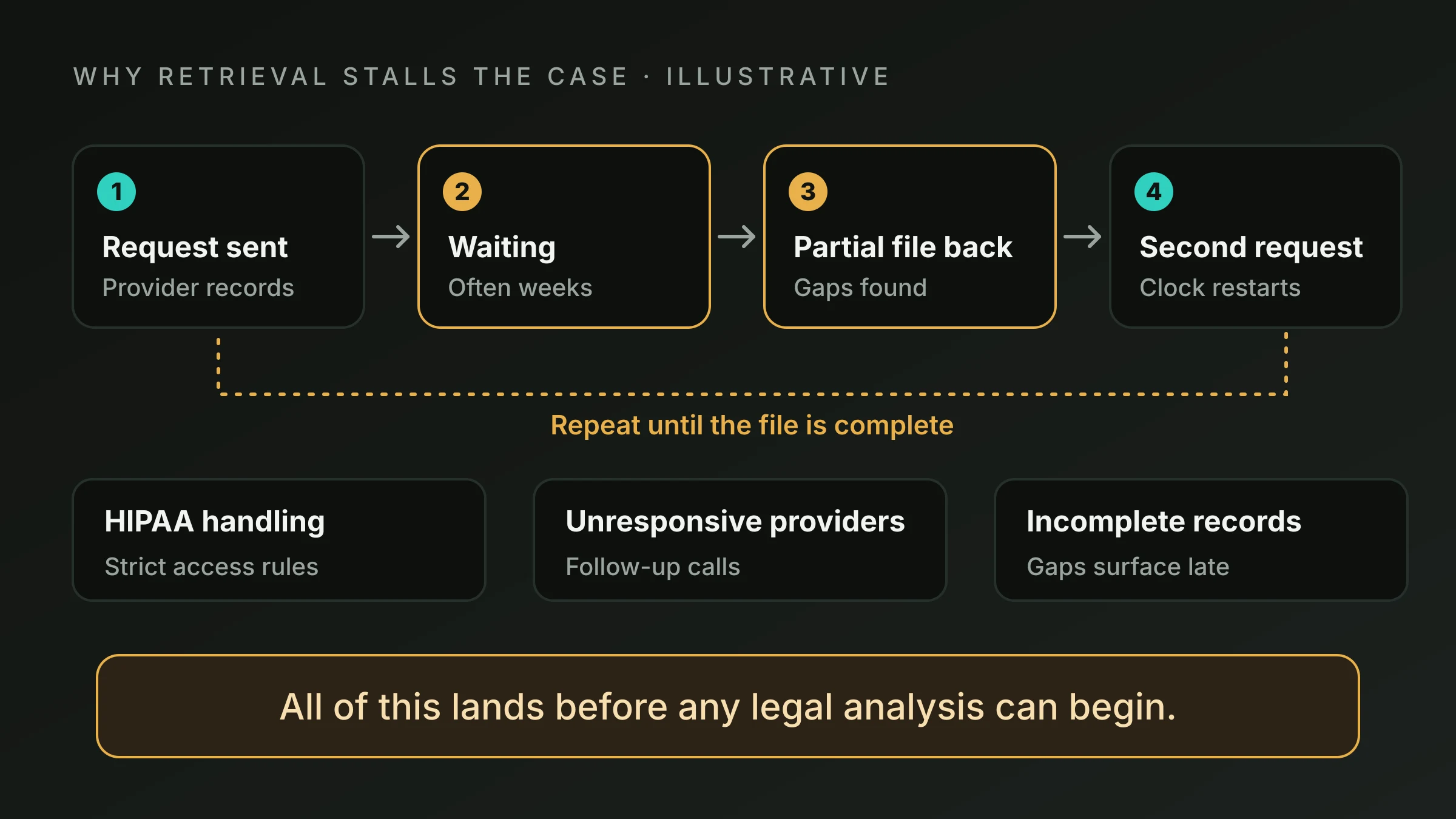
It forces your team to chase down, sort and read records one page at a time before any legal analysis can begin. Retrieval is a necessary step in building a personal injury, medical malpractice or mass tort case, but it's tedious for attorneys, legal nurse consultants and paralegals alike. The delay compounds as caseloads grow, deadlines get closer, and the odds of missing a detail go up.
Manual review means hours of work just to get through thousands of pages of charts, imaging reports and provider notes. A single file that touches several providers can take a legal nurse consultant or paralegal a full day or more to organize, and that's before chronologizing even starts. Multiply it across a caseload and your firm loses staff capacity that should be going toward strategy, depositions or settlement talks.
What else slows down the retrieval process?
Strict HIPAA requirements, unresponsive providers and incomplete documentation pile on top of the review time. Any of them can stall, or completely derail, your access to records that matter for strategy and valuation. Teams often wait weeks on a single provider, then find gaps that call for a second or third request.
Does technology change the equation?
It does. AI-assisted review works through thousands of pages in a fraction of the time manual review takes. It doesn't replace human judgment. It clears the volume bottleneck so attorneys and legal nurse consultants can spend their time interpreting findings instead of hunting for them. Pair automated processing with experienced human review and you close the gap between record receipt and a case-ready file.
What Happens When Record Productions Arrive Incomplete?
You get a second wave of work, long after the original request went out. Retrieval challenges don't end when a provider responds. A received file still needs scrutiny before anyone calls it case-ready. Billing statements, imaging studies or expected treatment records often go missing from a production, and some files cover a treatment period that no longer matches the client's actual care history.
That creates a false sense of completion. A "records received" label says almost nothing about whether the file can support litigation. Case managers and paralegals need a status that separates a complete file from one that has simply arrived.
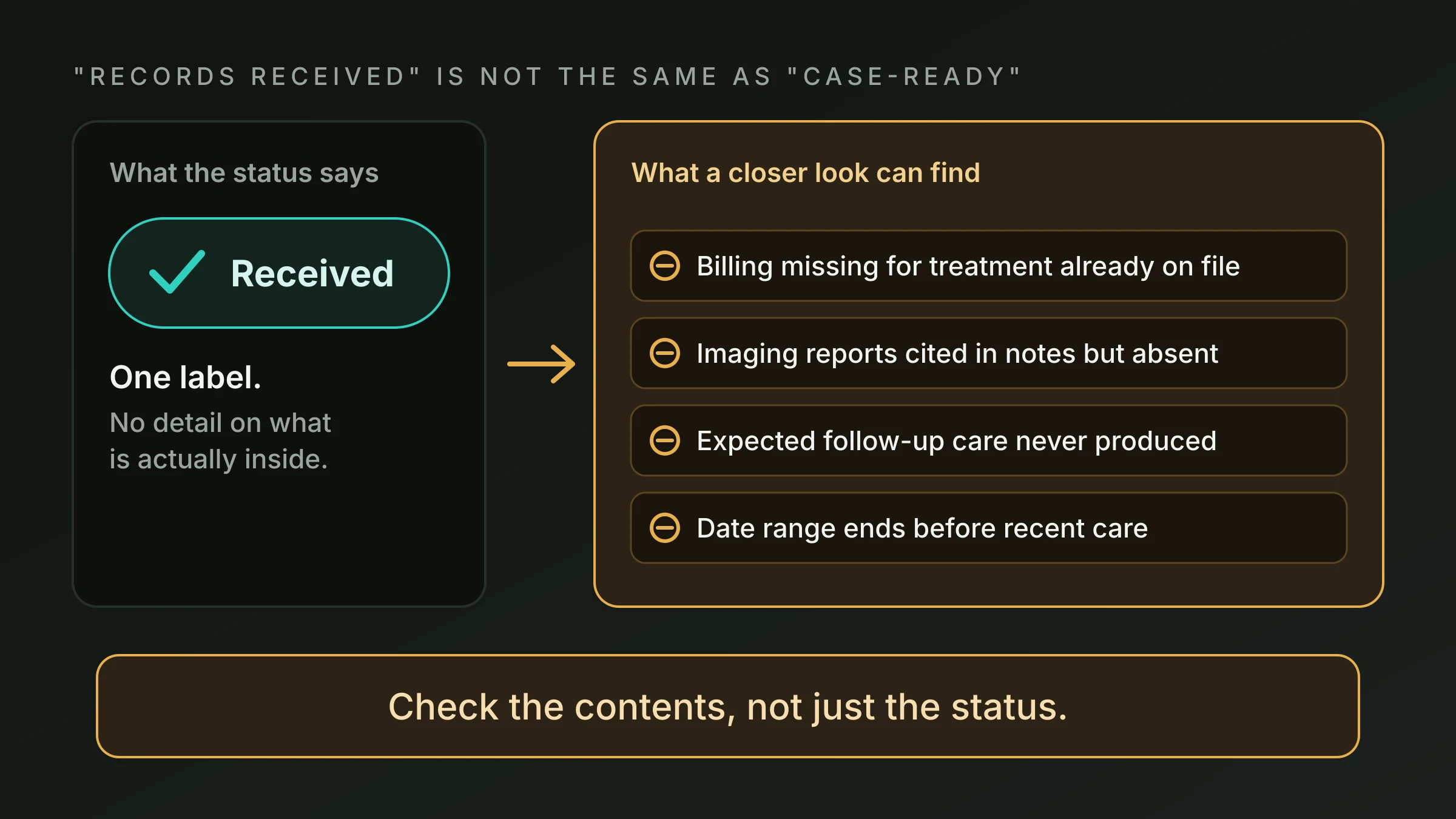
Common production gaps include:
- Missing billing documentation tied to treatment already on file
- Imaging reports referenced in notes but absent from the production
- Expected follow-up treatment that was never produced
- Records limited to a date range that excludes recent care
Why does a "received" status create risk for legal teams?
A simple received-or-pending status hides the condition of the file underneath it. If you rely on that label alone, you may build strategy or valuations on a record set that's quietly missing key documentation.
How does AttestaAI help close these gaps?
AttestaAI identifies hidden facts buried in medical files and maps each event across an interactive timeline. That surfaces inconsistencies, like a treatment referenced in a note but absent from the imaging section, before they turn up in a filing or a settlement demand. Your team gets a clearer picture of what the production actually contains, not just what it claims to contain.
Why Is Chronologizing Records So Time-Consuming?
Because your team has to read, sort and cross-reference thousands of pages from multiple providers before a single timeline takes shape. Every document arrives in its own format, with inconsistent dates, provider notes and billing codes that resist quick comparison. Attorneys and legal nurse consultants on personal injury, medical malpractice and mass tort files often lose entire days to sorting before any substantive case analysis can start.
AI-powered tools go after that bottleneck by scanning and summarizing large volumes of records and related documentation, such as email threads. They cut the time and cost of manual review, so teams can put those hours into case strategy instead of data entry. Files that once took days to reconcile become searchable in a much shorter review window.
What makes manual chronology building so error-prone?
Reviewers working under deadline pressure miss duplicate entries, skip pages or misdate treatment events, especially when records span dozens of providers. Fatigue adds to it on long mass tort files. A consistent, structured process lowers the chance that one missed entry undermines a causation argument at deposition or trial.
Does technology actually shorten the timeline process?
Yes. AI-generated chronologies reduce the administrative load on case teams and make the record set more consistent. You get structured, compliant organization instead of ad hoc spreadsheets built one page at a time.
| Approach | Primary burden | Outcome |
|---|---|---|
| Manual review only | High staff hours, fatigue-driven errors | Slower case prep, inconsistent accuracy |
| AI-assisted chronology | Reduced administrative load | Faster timelines, improved consistency |
With structured, technology-assisted review, attorneys get to focus on liability and damages analysis instead of document assembly. For a closer look at what the finished product contains, see our guide to the medical chronology summary.
How Can AI and Human Review Work Together?
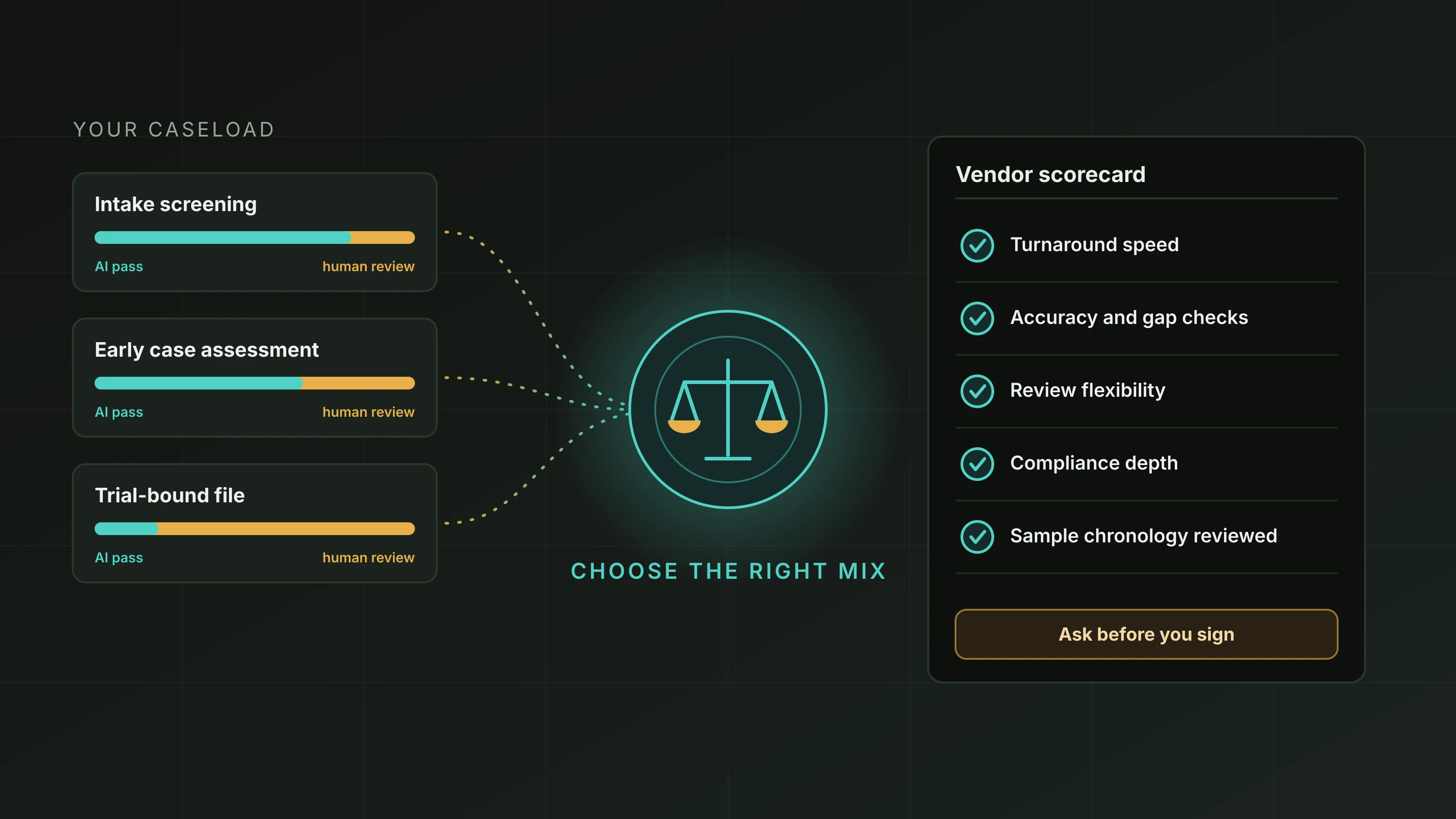
There are three review models: full human review, full AI review, and a hybrid that blends both. We build our services around that choice because organizing and chronologizing records calls for different levels of scrutiny depending on the matter. A mass tort intake screen and a trial-bound malpractice case carry different stakes, and pushing both through one identical process ignores that.
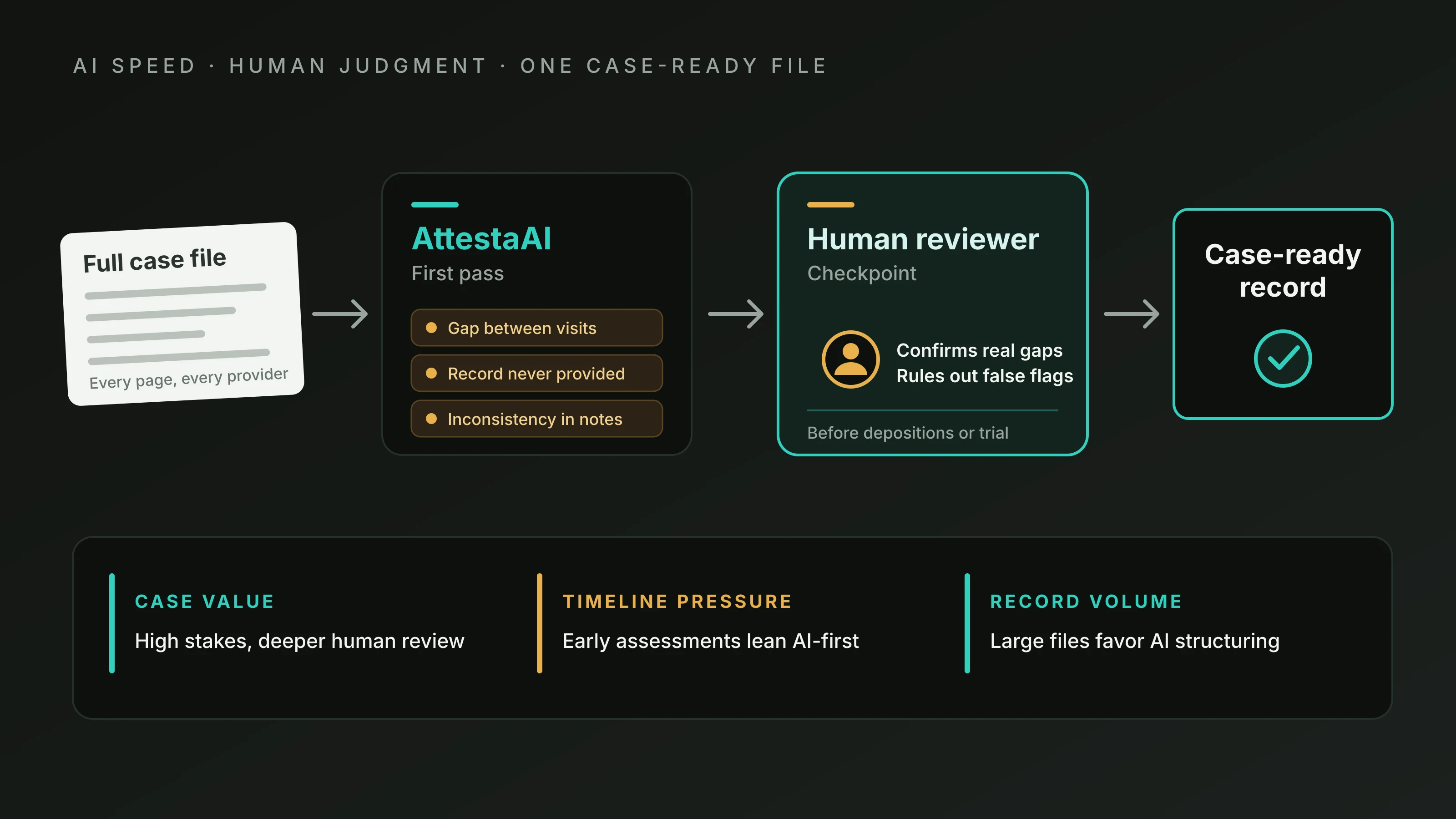
Legal nurse consultants and paralegals often juggle hundreds of pages per file, with speed and accuracy competing for priority. The hybrid model settles that by pairing AI-driven extraction with human verification at the points that matter. You pick the mix that fits the case instead of accepting a one-size-fits-all workflow.
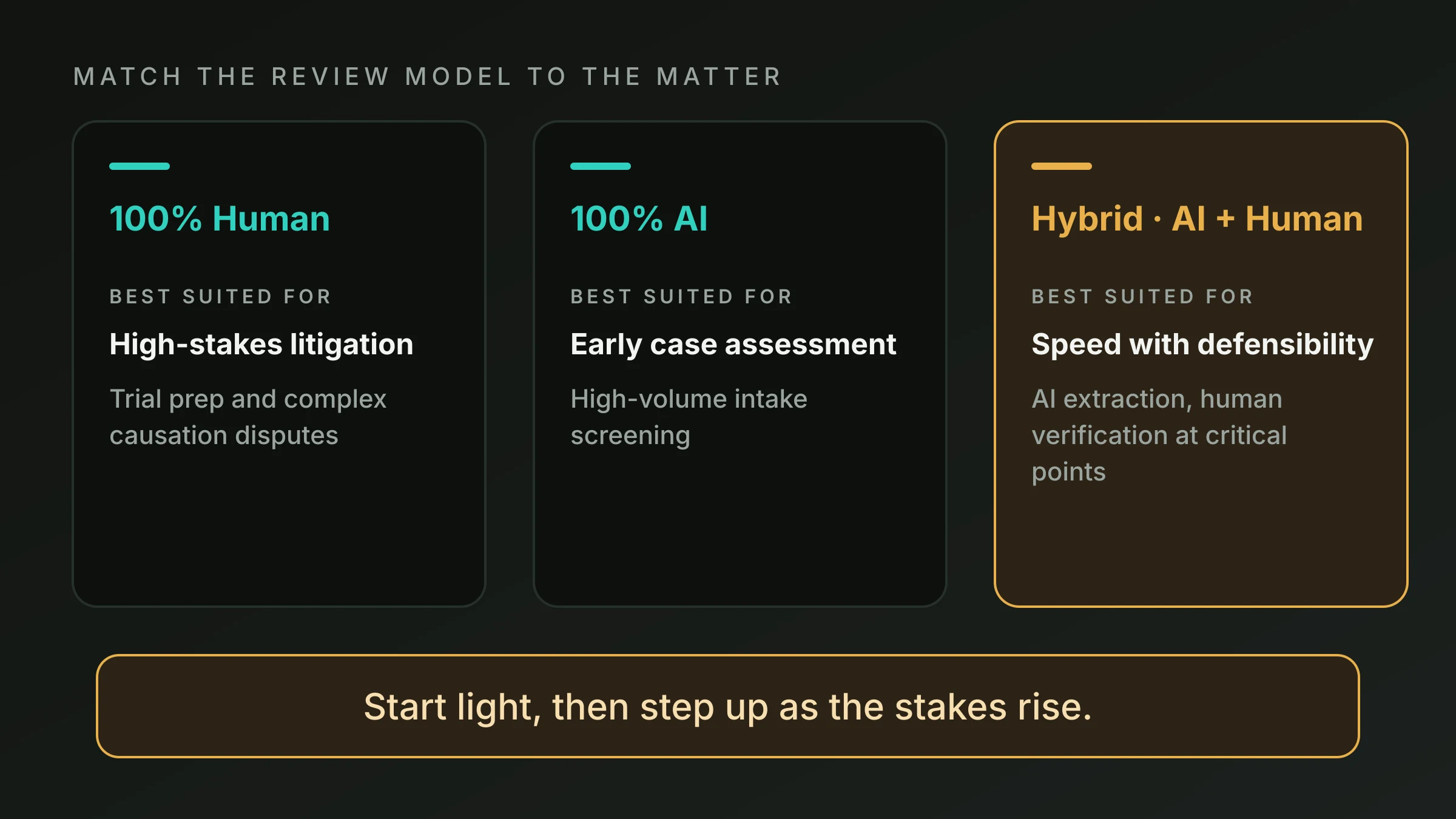
- 100% Human: high-stakes litigation, trial prep and complex causation disputes
- 100% AI: early case assessment and high-volume intake screening
- Hybrid (AI + Human): cases that need speed without sacrificing defensibility
Does combining AI and human review actually save time?
In our experience, yes. Pairing automated extraction with trained reviewers can cut record review times by up to 75% compared with manual-only processes. That matters most on mass tort dockets, where record volume alone can stall case progress.
Why not just use AI alone for every case?
AI handles volume well, but it doesn't bring the contextual judgment a seasoned reviewer does on disputed causation or inconsistent provider notes. Pairing automated screening with human oversight protects both throughput and defensibility. It also keeps you flexible. A managing partner can approve AI-only review for early case evaluation, then move to full human review once litigation heats up, without switching vendors or workflows midstream.
What Risks Come From Missed Medical Details?
Gaps that undermine case valuation, delay settlements and weaken credibility in the courtroom. Overlooked notes, skipped referrals or buried diagnostic codes can erase the evidence a case depends on. Attorneys rely on complete records to build strong, evidence-based personal injury cases, and any break in that chain threatens the claim.
Complex litigation often means sorting through thousands of pages from multiple providers. One missed entry, like a specialist referral or a follow-up imaging result, can shift the whole narrative on causation and damages. Legal nurse consultants and paralegals doing manual review feel that pressure on every sprawling file.
AI-driven review changes the picture. AttestaAI's algorithms are built to surface facts, patterns and trends buried in case documentation that a reviewer might miss on a first or even second pass. It can analyze records, email threads and deposition transcripts together to bring up correlations that would otherwise stay hidden until trial prep, or worse, cross-examination.
What happens when a key record gets overlooked?
An overlooked record can lower a settlement offer, trigger a discovery dispute or expose a weakness at deposition. Insurers and defense counsel look hard at gaps, and they use them to challenge causation or minimize damages.
Can AI reduce the risk of missed details?
Yes. AI review scans every page in a file, and that frees your team to work on case strategy instead of manual scanning. It moves review capacity toward work like:
- Verifying treatment timelines against billing records
- Flagging inconsistent provider notes
- Cross-referencing diagnostic codes with reported injuries
- Surfacing prior conditions relevant to causation disputes
Firms that pair human review with AI-assisted detection close these gaps before they reach a courtroom.
How Should Firms Choose a Review Model?
Firm size, case value and litigation stage drive the decision, not a fixed formula. A plaintiff firm handling mass tort intake faces different pressures than defense counsel preparing for trial, and the choice should match the stakes of each file. Most of the challenges in organizing and chronologizing medical records come down to one question: how much human oversight does this record set actually need?
Low-value cases rarely justify a full human review. For early case assessment, an AI-only pass may be the only review expense a firm can justify before deciding whether to move a claim forward. High-stakes litigation usually needs deeper human scrutiny alongside automated extraction, since a missed diagnosis or mislabeled date can undermine causation arguments months later.
A hybrid model often bridges the two. Automated indexing paired with specialist review catches errors AI alone might miss, without the cost of a fully manual read of every page.
Does record volume change the decision?
Yes. Larger record sets, common in mass tort and multi-provider malpractice claims, make AI-assisted sorting more valuable before human reviewers step in. With very large volumes, triage that flags the relevant entries first saves a lot of time.
Who actually reviews the file?
A specialist, every time. Each case gets personal attention, not an automated queue or a scripted reply, and you can expect direct specialist contact whichever review tier you choose. We've processed millions of pages annually for plaintiff and defense attorneys, insurers and legal professionals across the United States and Canada since 2007.
Frequently Asked Questions
What challenges do attorneys face when organizing medical records?
Disorganized records, slow retrieval and strict HIPAA requirements, especially in personal injury and mass tort litigation. Manual review adds error risk and pushes back case valuation.
Why does record disorganization threaten case strategy?
It hides critical evidence. Treatment notes, imaging and billing end up scattered across multi-provider files, and the gaps surface at a deposition or motion deadline. A missed referral or a conflicting diagnosis can undermine the whole case valuation.
Which medical record types must attorneys track for litigation?
Hospital and ER records, physician notes, diagnostic imaging and lab reports, billing statements, prescription records and prior medical history. Each one supports proving injury, treatment, costs or timelines.
Does a "records received" status mean a file is ready for the case?
No. A received file can still be missing billing, imaging reports, follow-up care or recent treatment dates. It needs a closer look before anyone calls it case-ready.
Conclusion
Organizing medical records takes more than manual effort. It works best as a partnership between human expertise and the right technology. Structure the records, extract the critical data points, build an actionable timeline, and an overwhelming pile of documentation becomes a case-ready asset.
Whether you choose human review, AI analysis or a hybrid, you can match the approach to each case's demands. That's how you protect your litigation strategy and your client outcomes.